
In today’s fast-paced business environment, customer experience can make or break an organization. One of the most critical touchpoints in service delivery is the waiting experience. Long queues, unclear wait times, and disorganized customer flow not only frustrate customers but also strain operational efficiency. This challenge led to the development of WAITWISE, a comprehensive cloud-based queue management system designed to transform how businesses handle customer flow across multiple industries.
The Problem: Beyond Just Lines
Traditional queue management systems often fall short in several key areas. Physical queue systems lack flexibility and scalability, manual token systems create bottlenecks at service points, and customers frequently experience uncertainty about wait times and service progress. Moreover, businesses struggle to gather meaningful data about service efficiency and peak hour patterns.
The impact of poor queue management extends beyond customer satisfaction. Walkouts represent lost revenue opportunities, inefficient staff allocation leads to wasted resources, and the inability to scale solutions across multiple locations creates operational silos. These pain points demanded a modern, technology-driven solution.
The WAITWISE Approach: Token-Based Intelligence
WAITWISE implements a sophisticated token-based queuing architecture that addresses these challenges through three core components: automated token generation and management, real-time display systems, and cloud-based centralized control.
Automated Token Generation
At the heart of WAITWISE is an intelligent token generation system. When customers arrive, staff operators can quickly generate and print tokens through an intuitive interface. Each token is assigned a unique identifier and linked to specific service parameters including the designated service counter, relevant department, and assigned service officer.
This automation eliminates manual errors and ensures consistent token issuance across all service points. The system maintains a persistent queue state, allowing it to recover gracefully from any interruptions without losing customer positions.
Real-Time Information Display
Customer communication is critical to managing expectations and reducing perceived wait times. WAITWISE addresses this through centralized display screens that show currently serving token numbers, designated counter assignments, assigned officer information, and estimated wait times based on historical service patterns.
This transparency transforms the waiting experience. Customers can make informed decisions about their time, staff can visually monitor queue status across all counters, and managers gain immediate visibility into service bottlenecks.
Cloud Architecture Benefits
The decision to build WAITWISE as a cloud-native application was strategic and offers significant advantages. Cloud deployment enables access from any location with internet connectivity, eliminates the need for on-premises server infrastructure, and provides automatic scaling to handle peak loads without manual intervention. Additionally, the architecture enables seamless updates and feature rollouts without service disruption.
For multi-location businesses, this architecture is transformative. A restaurant chain can monitor queue performance across all locations from a single dashboard, standardize service protocols while allowing location-specific customization, and aggregate data for enterprise-wide insights.
Technical Implementation Considerations
Building an effective queue management system requires careful attention to several technical domains, including real-time data synchronization, system reliability and fault tolerance, and user interface design for diverse user groups.
Real-Time Synchronization
Queue state must remain consistent across all system components simultaneously. This requires robust event-driven architectures where token generation, updates, and completion events propagate instantly to all connected displays and operator terminals. The system must handle concurrent operations gracefully, ensuring that two operators issuing tokens simultaneously don’t create conflicts or lost updates.
WebSocket connections or similar persistent communication channels maintain live connections to display screens, while optimistic UI updates provide immediate feedback to operators while background synchronization ensures data consistency.
Reliability Engineering
Service interruptions in queue management systems can cause significant operational disruption. WAITWISE employs multiple reliability strategies including persistent queue state storage that survives system restarts, automatic reconnection logic for temporary network interruptions, and graceful degradation when non-critical services are unavailable.
The system maintains audit logs of all queue operations, enabling troubleshooting and providing data for compliance or dispute resolution. Backup mechanisms ensure that even in edge cases, customer positions are preserved and service can continue.
Interface Design for Operational Efficiency
The operator interface must balance comprehensiveness with speed. Staff working in high-volume environments need to issue tokens quickly without complex workflows. The system provides keyboard shortcuts for common operations, visual confirmation of actions to prevent errors, and clear visibility into current queue state without overwhelming detail.
Similarly, the public display interface prioritizes readability at a distance, uses high-contrast colors and large fonts, and updates smoothly without jarring transitions that might cause confusion.
Impact Across Industries
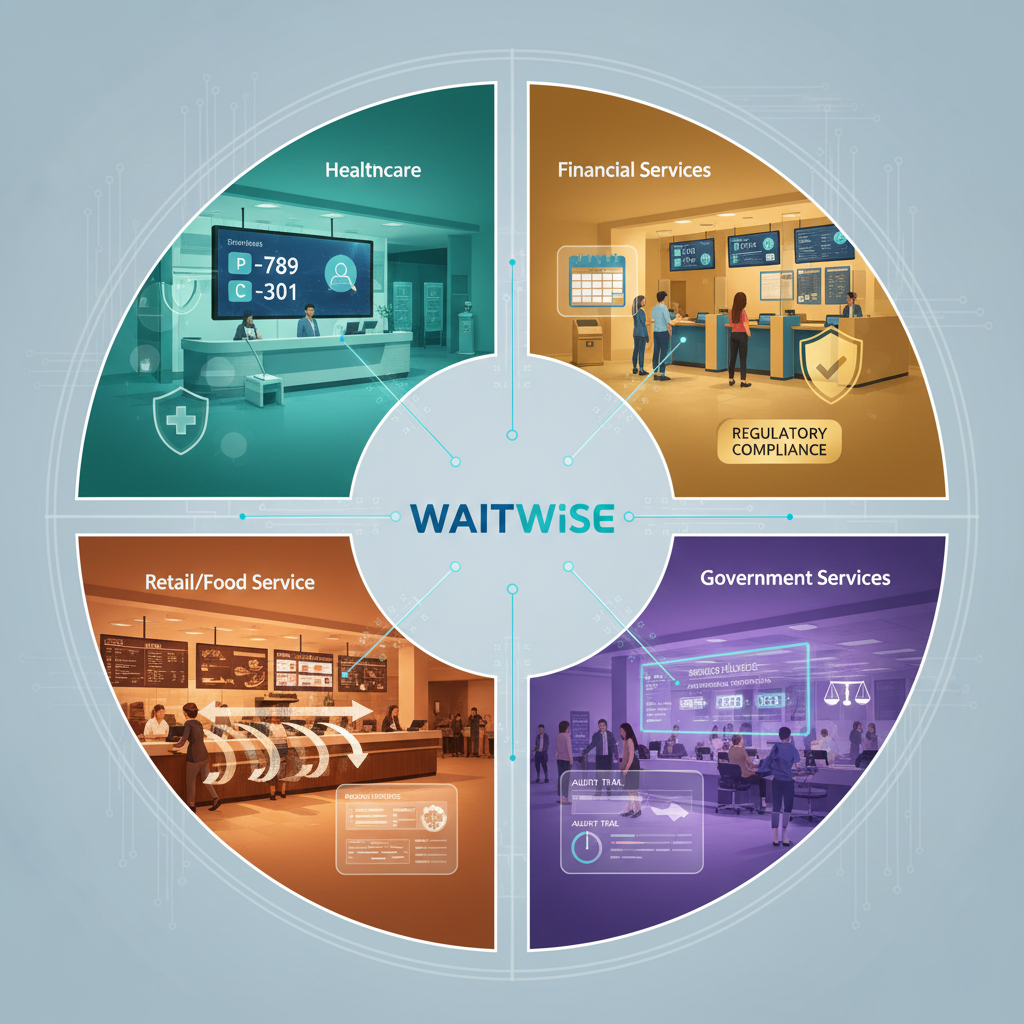
WAITWISE’S flexible architecture makes it applicable across diverse service sectors, each with unique requirements.
Healthcare Facilities
Hospitals and clinics manage complex patient flows across multiple departments and specialties. WAITWISE enables department-specific queues with appropriate routing, priority handling for urgent cases, and integration with electronic health record systems for streamlined check-in. Privacy considerations are paramount, using token numbers rather than patient names on public displays.
Financial Services
Banks and financial institutions require secure queue management with compliance considerations. WAITWISE supports service differentiation for different transaction types, integration with appointment systems for scheduled services, and reporting capabilities for regulatory requirements.
Retail and Food Service
High-volume retail and restaurant environments demand speed and simplicity. The system handles rapid token turnover during peak hours, supports multiple service stations operating in parallel, and provides analytics on service times to optimize staffing levels.
Government Services
Government offices serving citizens need fair, transparent queue management with full audit trails. WAITWISE provides equitable first-come-first-served processing, comprehensive logging for accountability, and multilingual support for diverse populations.
Operational Benefits and Metrics
The value of implementing WAITWISE extends across multiple operational dimensions.
Reduced Customer Walkouts
Clear visibility into wait times and queue position significantly reduces abandonment rates. Customers who know they’re next in line are far more likely to wait than those uncertain about when they’ll be served. Data from implementations shows measurable reductions in walkouts during peak periods.
Enhanced Staff Efficiency
Automated queue management frees staff from manual queue monitoring and customer queue inquiries. Service personnel can focus entirely on service delivery rather than administrative overhead. Managers can reassign staff based on real-time queue analytics rather than intuition.
Scalability Without Complexity
Perhaps most significantly, WAITWISE scales seamlessly from a single location to hundreds of branches. The cloud architecture means adding new locations requires minimal infrastructure investment and technical setup. Corporate oversight and analytics work identically whether managing two locations or two hundred.
Data-Driven Operations
Every transaction generates data about service times, peak hours, staffing efficiency, and customer flow patterns. This analytics capability enables continuous operational improvement through evidence-based decision-making rather than assumptions.
Future Directions and Extensibility
Queue management systems must evolve with changing customer expectations and technological capabilities. Several enhancement opportunities exist for systems like WAITWISE.
Mobile Integration
Customer mobile applications can extend the waiting experience by allowing customers to join queues remotely before arriving at the location, receive notifications when their turn approaches, and view real-time queue status from their devices. This reduces physical crowding and provides customers greater control over their time.
Predictive Analytics
Machine learning models can analyze historical patterns to predict wait times more accurately, identify unusual patterns that might indicate operational issues, and optimize staff scheduling based on anticipated demand.
Appointment System Integration
Combining queue management with appointment scheduling creates a comprehensive customer flow solution. Walk-in customers can be managed alongside scheduled appointments, and no-show detection can automatically adjust queues and potentially offer time slots to waiting customers.
Third-Party Integrations
APIs can enable integration with customer relationship management systems, business intelligence platforms, and facility management systems, creating a comprehensive operational ecosystem.
Lessons Learned in Development
Building a production-ready queue management system provided several valuable insights about real-time systems, user expectations, and operational software.
Real-time consistency is harder than it appears. Edge cases around network interruptions, concurrent operations, and state synchronization require careful design and extensive testing. Simplicity in operator interfaces is crucial but challenging to achieve. The temptation to add features must be balanced against the need for speed in high-volume environments.
Reliability cannot be an afterthought. Users expect queue systems to work flawlessly because failures have immediate, visible operational impact. Building in redundancy and graceful degradation from the start is far easier than retrofitting it later. Finally, different industries have surprisingly different queue management needs. What works perfectly in a bank may be completely inappropriate for a restaurant. Configurable flexibility is essential.
Conclusion
WAITWISE represents a modern approach to a timeless challenge: managing customer flow efficiently while maintaining service quality. By leveraging cloud technology, real-time data synchronization, and user-centered design, it addresses the pain points of traditional queue management while providing the scalability and analytics capabilities that modern businesses require.
The system demonstrates that even well-understood operational problems can benefit from fresh technological approaches. Queue management isn’t just about organizing lines; it’s about optimizing the entire service experience for both customers and staff. As businesses continue to prioritize customer experience and operational efficiency, solutions like WAITWISE become not just convenient but essential.
For organizations struggling with long wait times, customer walkouts, or operational inefficiency across multiple locations, evaluating modern queue management solutions should be a priority. The technology exists to transform waiting from a source of frustration into a smoothly managed component of excellent service delivery.
To learn more about WAITWISE or explore how it might benefit your organization, visit waitwise.kingslee.net or contact us at info@kingslee.net.
Discover more from Kingslee
Subscribe to get the latest posts sent to your email.